
Lighting for Health: How the Right Light Supports Sleep, Focus, and Comfort

The light in your home does more than help you see. It quietly shapes when you feel awake, when you concentrate, and when your body finally decides it is ready for sleep. The right light, at the right time of day and the right warmth, can support better sleep, sharper focus, and a room that simply feels calm to be in. The wrong light does the opposite, and most people never notice it is happening.
This is what “lighting for health” means. Not a gadget, not a wellness trend. Just light that works with your body instead of against it.

What "lighting for health" actually means, in simple terms

Lighting for health means using the brightness and warmth of light to match your body’s natural daily rhythm. That rhythm has a name: the circadian rhythm. It is the roughly 24-hour internal clock that tells your body when to feel alert and when to wind down. Your brain reads this clock from one signal above all others: light.
Here is the part most people do not know. Inside your eye there are special cells that are not really for seeing at all. They exist to sense light and report it to your brain’s clock. These cells are most sensitive to the cool, bluish light you get from the midday sky. When they see a lot of it, your brain assumes it is daytime and keeps you alert. When that light fades to something warm and dim, your brain assumes evening is coming and begins preparing you for rest.
For most of human history, the sun handled all of this. Indoors, under fixed electric light that looks the same at 7 in the morning as it does at 11 at night, that natural signal gets muddled. Good residential lighting design puts the signal back.

Why light has such a strong effect on sleep

Light affects sleep because it controls melatonin, the hormone that makes you feel sleepy. Bright, cool light in the evening tells your brain to hold melatonin back, which can delay how quickly you fall asleep. Warm, dim light in the evening allows melatonin to rise on schedule.
The numbers here are striking. In a study of 116 adults, ordinary room light in the hours before bed suppressed melatonin by more than 50 percent, and cut roughly 90 minutes off the window in which the body produced it, compared with dim light. In plain terms, a normally lit room at night can push your body’s “time for sleep” signal back by about an hour and a half.
Source: Gooley et al., 2011, Journal of Clinical Endocrinology & Metabolism, Brigham and Women’s Hospital. View study.

Why light has such a strong effect on sleep

Melatonin, the hormone that makes you sleepy, compared under two evening light conditions
Warm, dim light
Full melatonin 100%
Ordinary room light
Down 50%+ 50%
Melatonin Suppressed
0 %+
Shorter Sleep-Signal Window
~ 0 min
Adults Studied
0

Effect of evening light on melatonin (Gooley et al., 2011)

Evening light condition Melatonin level Sleep-signal window
Warm, dim light Full (baseline) Normal duration
Ordinary room light Suppressed by more than 50% About 90 minutes shorter
Ordinary evening room light pushes your body’s “time for sleep” signal back by roughly an hour and a half.
Data source: Gooley et al., 2011. https://doi.org/10.1210/jc.2010-2098

What the science actually recommends

In 2022, a consensus of 18 leading circadian scientists put a simple pattern to all of this. Bright light through the day, measured at eye level. Very low light in the three hours before bed. A near-dark room for sleep. You do not need a light meter on your wall. The takeaway is the shape of the day: strong light early, soft light late, darkness at night.
Source: Brown et al., 2022, PLOS Biology, consensus recommendations for indoor light exposure. View study.

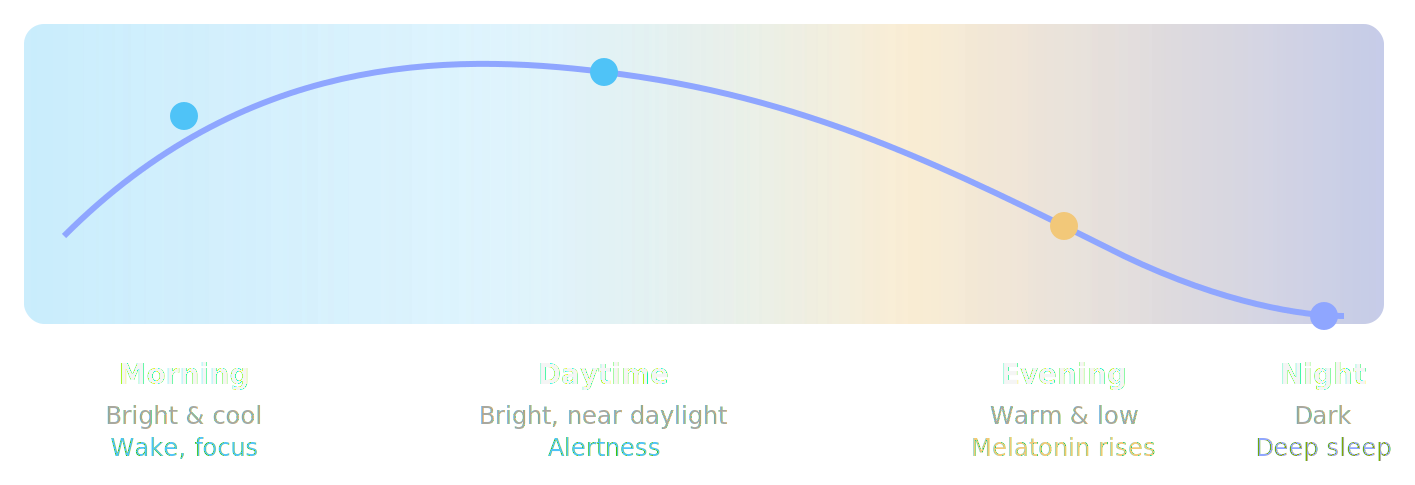
Your light across a healthy day

Brightness and warmth shift through the day to match your body clock
Curve = light intensity. Colour = warmth of the light, cool at left, warm then dark toward night.

A healthy daily light pattern (adapted from Brown et al., 2022)

Time of day Light level Warmth What it supports
Morning Bright Cool Waking up, early focus
Daytime Bright, close to daylight Neutral to cool Alertness and concentration
Evening (about 3 hours before bed) Low Warm Letting melatonin rise
Night (sleep) Near dark Off or minimal warm glow Deep, uninterrupted sleep
The whole thesis in one picture: strong light early, soft light late, darkness at night.
Data adapted from Brown et al., 2022. https://doi.org/10.1371/journal.pbio.3001571

What kind of light helps you focus?

The light that helps you focus is brighter and cooler, closer to daylight, and it works best earlier in the day. When you are reading, working from a home study, cooking, or helping a child with schoolwork, a cooler and brighter setting supports alertness and reduces the heavy, sleepy feeling that dim warm light can bring on during the day.
This is also why daytime brightness matters indoors. Building health standards such as WELL set daytime light targets specifically to support alertness and healthy circadian timing, because most indoor spaces sit far below the light levels our bodies evolved to read as “daytime.”
Source: WELL v2 and UL 24480 circadian lighting provisions, summarised in the Frontiers in Neurology review on human-centric lighting. View review.
The reverse is just as important. A home office lit with warm, restaurant-style light may look inviting in a photo, but it can leave you foggy through an afternoon of concentration. Matching the light to the task is the quiet difference between a room that helps you work and one that fights you the whole time.
A word of honesty here, because it matters. Light is one factor among many. Sleep quality, focus, and mood are also shaped by age, stress, screen habits, exercise, and health. Lighting will not fix everything. What good lighting does is remove one obstacle that is working against you every single day, usually without your knowledge.

Comfort: how light changes the way a room feels

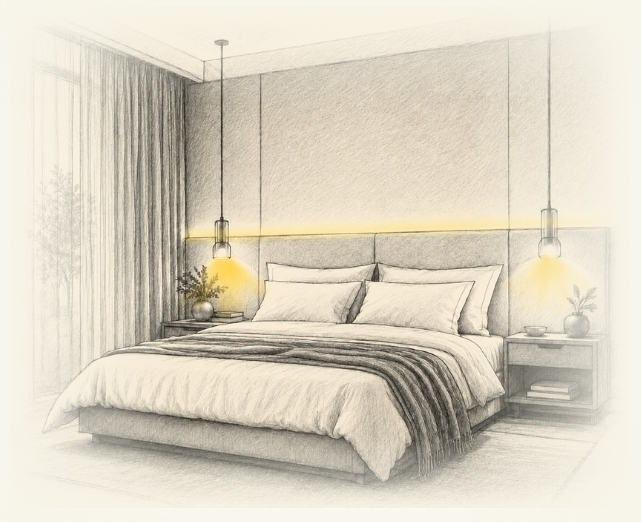
Comfort in a room comes less from how much light there is and more from how it is layered and where the glare is hidden. A single bright ceiling fixture lights a room, but it rarely makes it feel good. The rooms people call calm almost always use several softer sources at different heights: a warm wash near the floor, a pool of light over a table, a gentle glow along a wall, no harsh bulb shining into your eyes.
This is where warmth, dimming, and placement do their work. Comfort is engineered, not accidental. It is the result of decisions about layers, angles, and control made long before the first fitting goes up.

What colour temperature means for your home

Colour temperature is simply how warm or cool a light looks, measured in a unit called Kelvin, written as K. Lower numbers look warm and golden. Higher numbers look cool and white. You do not need to memorise the science, but a few reference points make choosing light much easier.

The colour temperature scale for your home
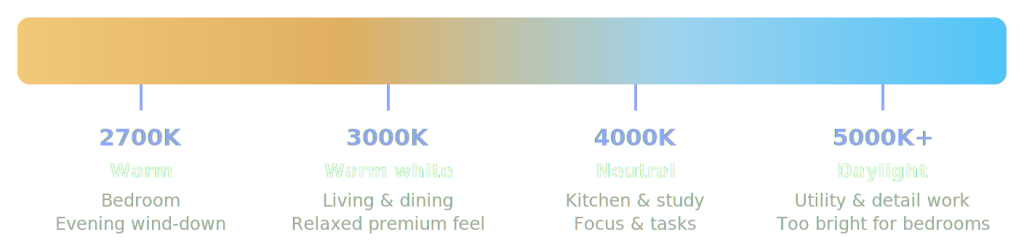
Measured in Kelvin (K). Warm and golden on the left, cool and white on the right.
The best homes do not pick one setting. Tunable white lighting moves warmer as the day winds down.

Colour temperature guide for the home

Kelvin Appearance Best rooms Best used for
~2700K Warm, golden Bedrooms Evening wind-down and sleep readiness
~3000K Warm white Living and dining A relaxed, premium feel
~4000K Neutral white Kitchens and study areas Focus and detailed tasks
5000K and above Cool daylight Utility and task areas Fine detail work; too stimulating for bedrooms at night
Turn an abstract unit into a decision: which warmth belongs in which room, at which time.
The most useful home lighting does not pick one of these and stop. It changes. Cooler and brighter when you need to be awake and productive, warmer and softer as the day winds down. Light that can move across this range on its own is called tunable white lighting, and it is the foundation of lighting designed around health rather than habit.

How the right lighting actually gets set up at home

The right lighting gets set up through a design and control layer that adjusts brightness and warmth automatically through the day, so you are not left flipping switches to chase the correct setting. This approach is known as human-centric lighting, and the discipline that makes it run is Lighting Controls.
Lighting Controls is the system that decides which lights come on, how bright they are, how warm they are, and at what time. Instead of a wall of switches, a home runs on scenes. A morning scene brings up cooler, brighter light as the day begins. An evening scene warms and lowers the whole home. A late-night scene leaves only a soft, low glow along the paths you actually use. The lighting follows the rhythm of the day, and the house begins to feel like it understands the hour.
At VISTABABBLER, this is where over two decades of commissioning residential and premium hospitality environments comes in. Lighting Controls is the entry point to how a home is engineered around the people living in it, drawing on established platforms such as Lutron for the control layer. Lighting is a discipline in its own right. It sits alongside, but is separate from, the broader building systems a home may later need, and it is almost always the first thing a well-designed residence gets right.

The result is not a house full of technology on display. It is the opposite. The equipment recedes into the architecture, the switches simplify, and what remains is a home that is easier to sleep in, easier to focus in, and more comfortable to live in. The best lighting is the kind you stop noticing, because it is finally doing its job.

Frequently asked questions

What is circadian lighting?

Circadian lighting is lighting that changes its brightness and warmth through the day to match your body’s natural 24-hour clock. It is brighter and cooler during the day to support alertness, and warmer and dimmer in the evening to support sleep.

Warm, low light is best before sleep, roughly in the 2700K range. Cool, bright, bluish light in the evening can delay sleep by holding back melatonin, the hormone that makes you feel drowsy. The bedroom itself is best kept as dark as possible while you sleep.

Quite a lot. Research found that exposure to ordinary room light before bed suppressed melatonin by more than 50 percent and shortened its production by about 90 minutes compared with dim light. This is why warm, low light in the evening genuinely helps you fall asleep.
Yes. The light-sensing cells in your eyes are most sensitive to blue-toned light, and strong exposure in the evening signals your brain that it is still daytime. This can delay how quickly you fall asleep, which is why warm, dim light is better at night.

Brighter, cooler light closer to daylight supports focus and works best earlier in the day. A home office or study benefits from a neutral white around 4000K during working hours rather than warm, low light, which tends to feel relaxing rather than alerting.

Yes. A Lighting Controls system can shift brightness and warmth automatically across the day using preset scenes, so the home moves from bright morning light to a warm evening setting without anyone adjusting a switch. This is the practical foundation of lighting designed for health.

The Takeaway

Light is the one thing in your home you use every waking hour and think about almost never. Get its timing and warmth right and it quietly supports how you sleep, how you focus, and how a room feels to be in. Get it wrong and it works against all three, invisibly, day after day.
Getting it right depends less on the fittings and more on the practice behind them. This is what an integrated engineering practice is for. One team designs the lighting, commissions it, and stays accountable for how it performs long after the handover. Lighting Controls is usually where that relationship begins, and it is the same practice that engineers the systems a home grows into over the years, all held in-house under a single line of accountability. One contract. One partner for the life of the building.
Great homes begin with great light. That is where VISTABABBLER begins too, with Lighting Controls that work quietly around the people living in the home. Because the best systems are never the ones you notice. They are the ones you feel.

References

Gooley, J. J., et al. (2011). Exposure to Room Light before Bedtime Suppresses Melatonin Onset and Shortens Melatonin Duration in Humans. Journal of Clinical Endocrinology & Metabolism, 96(3), E463-E472. https://doi.org/10.1210/jc.2010-2098
Brown, T. M., et al. (2022). Recommendations for daytime, evening, and nighttime indoor light exposure to best support physiology, sleep, and wakefulness in healthy adults. PLOS Biology, 20(3), e3001571. https://doi.org/10.1371/journal.pbio.3001571
Houser, K. W., & Esposito, T. (2021). Human-Centric Lighting: Foundational Considerations and a Five-Step Design Process. Frontiers in Neurology, 11, 630553. https://doi.org/10.3389/fneur.2021.630553