

A good hotel room does not ask the guest to understand its lighting. You walk in, press one button, and the room settles into the right mood. The bedside light falls where you need it. The bathroom is bright without being harsh, and at night you can cross the room without switching everything on.
When hotel lighting is designed well, most of the work disappears. That ease is not luck. It comes from how the room is zoned, layered, dimmed, and commissioned long before the first guest arrives. The aim is not to impress with technology, but to make the room easy to live in.
What makes a hotel room feel effortless?
A hotel room is unlike a home because the guest has no time to learn it. At home, you slowly work out which switch does what. In a hotel, the lighting has to make sense at once.
A guest arriving late should not have to test six switches to find a comfortable setting. What matters is not the number of fixtures but how naturally they work together.
When arrival, reading, and moving in the dark each feel easy, the room feels designed.
Why one bright ceiling light is not enough
A hotel room packs many functions into one space. The bed is for resting and reading, the desk for work, the bathroom needs task light, and the seating should feel calmer. At night, someone has to move safely without waking the whole room.
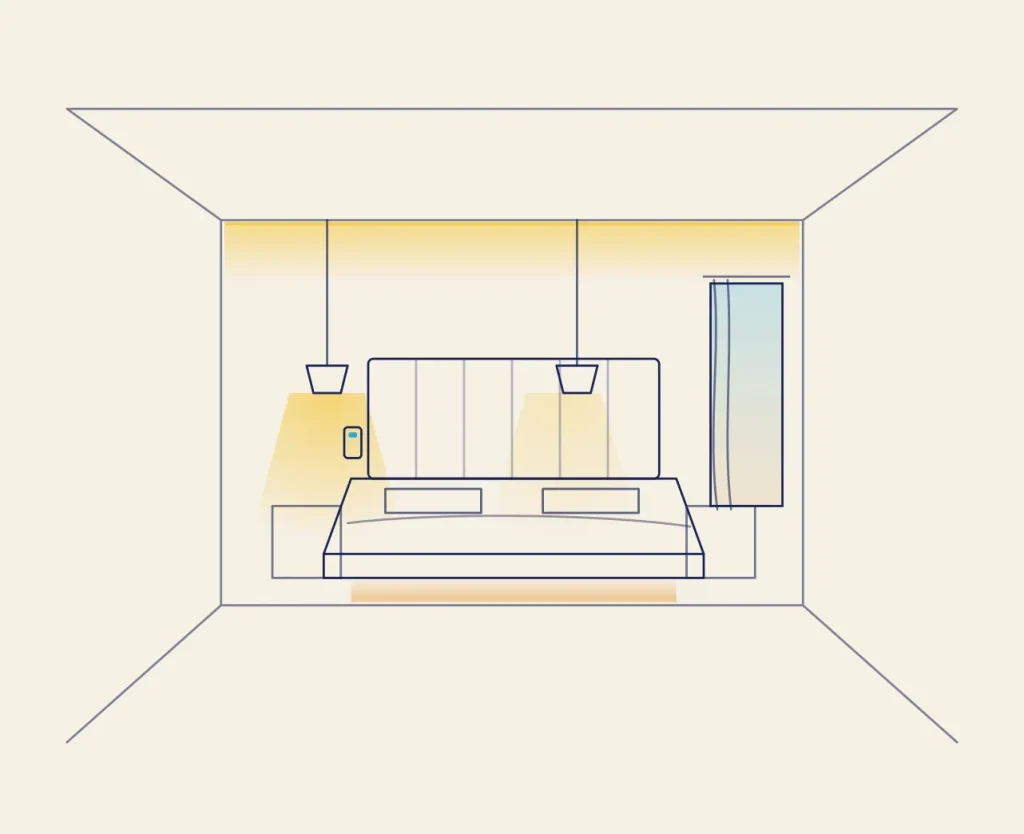
No single ceiling source does all of that well, which is why hotel lighting works best in layers. Ambient light gives general brightness. Task light supports reading and working. Accent light draws attention to materials or architectural detail. Decorative fittings give the room character. Low-level light makes movement easier after dark.
Ambient
Gives the room general brightness
ExampleCove or recessed lightingTask
Supports a specific activity
ExampleReading light or desk lightAccent
Adds depth and focus
ExampleWall wash or artwork lightingDecorative
Gives the room visual identity
ExampleBedside pendant or feature lightLow-level
Supports movement at night
ExampleSkirting or under-bed lightingA hotel room feels comfortable when each layer has a clear job.
Why lighting zones matter
Layering describes the kinds of light. Zoning decides which parts of the room are controlled separately, splitting the entrance, the bed, the desk, the bathroom, and the night lighting.
This matters because the guest rarely needs everything on at once. One guest can read while the other sleeps, and a late trip to the bathroom should not mean the main ceiling lights.
Good zoning gives the room flexibility without making it feel complicated.
Why the arrival scene matters
The first few seconds inside a room decide how it feels. Open the door to total darkness and the space feels unfinished. Open it to every light at full output and the room feels flat and exposed.
A good arrival scene sits between the two. The entrance is gently lit, ambient light reveals the room, a wall wash gives it depth, and the bed area stays softer.
The point is not drama for its own sake. It is to let the guest read the room instantly: where they are, how it is organised, and that the lighting can be left alone.
Why bedside lighting matters so much
The bed is usually the centre of the room, and the light around it has several jobs at once. A guest may want to read without disturbing the person beside them, or switch the whole room off without getting up.
Reading lights should fall on the book, not the guest’s face or the whole room. Bedside controls should be obvious, and a master-off should be within reach.
The best bedside lighting is specific rather than generous.
What makes bathroom lighting feel comfortable?
Hotel bathrooms need more light than most of the room, but brightness alone does not make them good. The mirror is the critical part. A downlight straight above the head throws hard shadows under the eyes and chin, while lighting brought toward the face more evenly makes grooming easier.
At the same time, the bathroom should not be clinically bright at every hour. A guest using it in the night may want only a low glow, not the full vanity and ceiling.
Bathroom lighting should help the guest see clearly without making every moment equally bright.
Why glare control changes the whole room
A suite can use costly materials and beautiful fittings and still feel uncomfortable if the guest keeps catching bright sources in the eye. Glare tends to appear when downlights run too strong or when a fitting sits in the line of sight.
It shows most from the pillow: a light that seems harmless while standing, but can become uncomfortable when seen from lying down. So hotel lighting should be judged from where the guest actually spends time, not from the doorway.
Comfort depends not only on how much light reaches the room, but on where it comes from.
Why low-level night lighting matters
Late at night the requirement changes completely. The guest may only need to reach the bathroom or move without waking someone, and turning on the main lights breaks the moment at once.
Low-level light solves this with just enough to move by, set beneath the bed, along the skirting, or near the bathroom entrance, kept away from the eyes.
A small detail that makes the room feel considered.
Why dimming matters in a hotel room
A room needs to shift between brightness levels through the day, brighter for cleaning, softer in the evening, and lower still before sleep. Dimming lets the physical lighting stay the same while the atmosphere changes.
The quality of that dimming matters. If fittings flicker, jump between levels, or cut out before a comfortable low setting, the room feels unfinished. Smooth dimming is not something the guest should notice.
The room simply becomes quieter.
Why curtains and daylight should work with the lighting
A room behaves very differently in the morning and at night. By day, natural light does much of the work, and the electric lighting should support it rather than fight it.
Motorised curtains can join a scene: a daytime arrival may open the curtains and use little electric light, while an evening arrival leans on warm interior sources.
The aim is to make daylight and electric light feel like parts of one room.
Why simple controls matter more than clever controls
A guest should never need instructions to turn off the lights. That sounds obvious, yet control complexity is one of the fastest ways to make a refined room frustrating. Too many buttons create doubt, and touchscreens turn irritating when basic functions hide inside menus.
The important controls should be plain: how to turn the room on, switch it off from the bed, and use the bathroom at night.
A good control system hides its complexity rather than passing it to the guest.
Why scenes make hotel rooms easier to use
Rather than set every light, the guest can lean on a few well-judged scenes built around common moments.
Welcome
Balanced ambient and accent lighting
Work
Brighter desk and task lighting
Relax
Softer general light with selected accents
Reading
Focused bedside light with reduced ambient lighting
Night
Minimal low-level circulation lighting
All Off
Room lighting switched off from one control
The guest chooses the moment, and the room handles the individual circuits.
The best scenes are few and clear. Too many are as confusing as a wall of switches.
Why commissioning makes the room feel finished
A room can look right on drawings and feel wrong once it is built. That is what commissioning corrects.
After the finishes, fixtures, curtains, and controls are in, the lighting is tuned in the finished room: a reading light that is too strong comes down, a wall wash that competes with the television is pulled back. These adjustments are small, and hospitality is built from small details.
Commissioning is where the design becomes an experience.
Frequently asked questions
What colour temperature is best for hotel rooms?
Warm white suits bedrooms and relaxation areas because it feels softer, while task areas may use a more neutral appearance. Consistency across the room matters more than mixing many colour temperatures.
Should every hotel room light be dimmable?
Not necessarily, but the ambient, decorative, and bedside layers benefit a great deal from dimming. Task and service lighting can follow how the room is meant to operate.
Why are hotel room lights divided into zones?
Zoning lets parts of the room work independently, so a guest can read without lighting the whole room, or use night lighting without the main lights.
What is the most important hotel-room lighting control?
It varies by project, but a clear bedside master-off is hard to beat. A guest should not have to leave the bed to switch off.
Why is commissioning important in hotel rooms?
It lets levels, scenes, dimming, and timings be adjusted once the finished room can be experienced, which is where problems that drawings cannot predict get corrected.
The takeaway
An effortless hotel room is not the one with the most lighting. It is the one where the guest barely thinks about lighting at all. The entrance welcomes them, the bed reads well, the bathroom is clear without being harsh, and moving around at night does not wake the room.
That simplicity is built from decisions the guest never sees: layering, zoning, glare control, dimming, scenes, daylight coordination, and proper commissioning. Holding those together is the discipline of Lighting Controls, drawing on over two decades of residential and premium hospitality work and platforms such as Lutron. It sits alongside the broader building systems a property runs on, all held in-house under one line of accountability. One contract. One partner for the life of the building.
Planning the lighting for a hotel or serviced-apartment project? Book a consultation to walk through zoning, scenes, and commissioning for your rooms. For why smooth dimming depends on more than the switch, read A Homeowner’s Guide to Dimming.
When those pieces work together, the technology recedes, and what remains is a room that simply feels easy to be in.
References
Illuminating Engineering Society. (2026). IES Lighting Library: Standards and Recommended Practices for Lighting Design, Visual Comfort, Maintenance, and Commissioning.
International Commission on Illumination. (2024). Assessment of Discomfort Glare from Daylight in Buildings. CIE 252:2024.
DALI Alliance. (2026). DALI Library and Technical Resources for Digital Lighting Control, Dimming, Scenes, Groups, and Commissioning.
International Electrotechnical Commission. (2024). IEC 61347-2-13: Controlgear for Electric Light Sources – Particular Requirements for Electronic Controlgear for LED Light Sources.
International Electrotechnical Commission. (2024). IEC 61347-1: Controlgear for Electric Light Sources – General Requirements.