

What "lighting for health" actually means, in simple terms
Why light has such a strong effect on sleep
Why light has such a strong effect on sleep
Effect of evening light on melatonin (Gooley et al., 2011)
| Evening light condition | Melatonin level | Sleep-signal window |
|---|---|---|
| Warm, dim light | Full (baseline) | Normal duration |
| Ordinary room light | Suppressed by more than 50% | About 90 minutes shorter |
What the science actually recommends
Your light across a healthy day
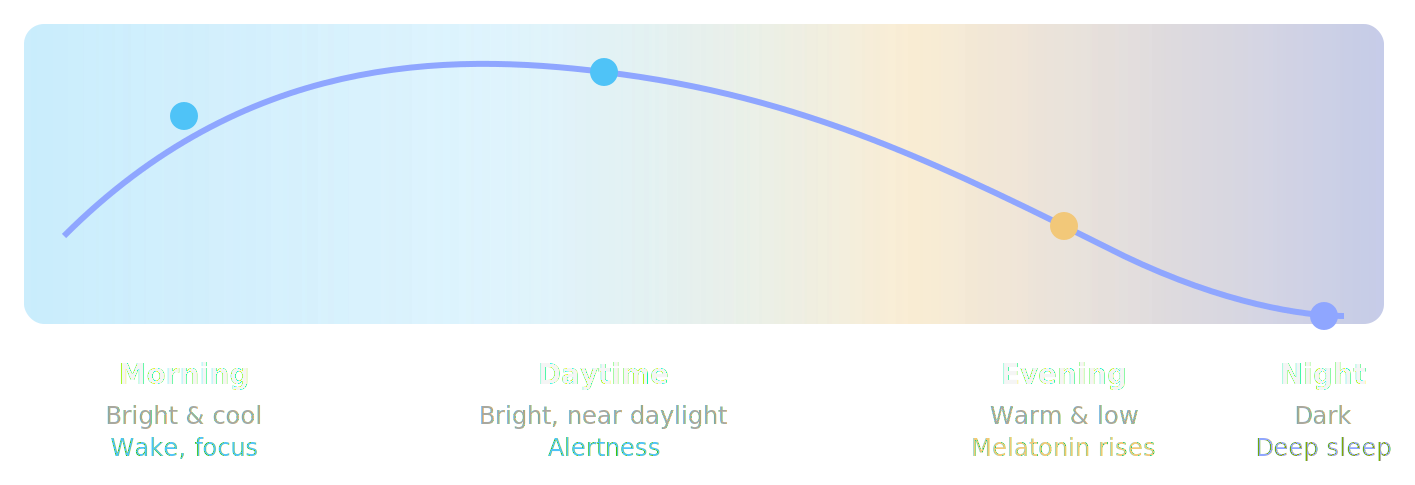
A healthy daily light pattern (adapted from Brown et al., 2022)
| Time of day | Light level | Warmth | What it supports |
|---|---|---|---|
| Morning | Bright | Cool | Waking up, early focus |
| Daytime | Bright, close to daylight | Neutral to cool | Alertness and concentration |
| Evening (about 3 hours before bed) | Low | Warm | Letting melatonin rise |
| Night (sleep) | Near dark | Off or minimal warm glow | Deep, uninterrupted sleep |
What kind of light helps you focus?
Comfort: how light changes the way a room feels
What colour temperature means for your home
The colour temperature scale for your home
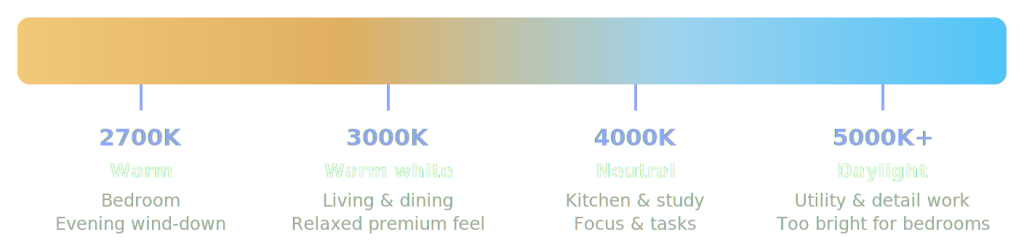
Colour temperature guide for the home
| Kelvin | Appearance | Best rooms | Best used for |
|---|---|---|---|
| ~2700K | Warm, golden | Bedrooms | Evening wind-down and sleep readiness |
| ~3000K | Warm white | Living and dining | A relaxed, premium feel |
| ~4000K | Neutral white | Kitchens and study areas | Focus and detailed tasks |
| 5000K and above | Cool daylight | Utility and task areas | Fine detail work; too stimulating for bedrooms at night |
How the right lighting actually gets set up at home
The result is not a house full of technology on display. It is the opposite. The equipment recedes into the architecture, the switches simplify, and what remains is a home that is easier to sleep in, easier to focus in, and more comfortable to live in. The best lighting is the kind you stop noticing, because it is finally doing its job.
Frequently asked questions
What is circadian lighting?
Circadian lighting is lighting that changes its brightness and warmth through the day to match your body’s natural 24-hour clock. It is brighter and cooler during the day to support alertness, and warmer and dimmer in the evening to support sleep.
What colour light is best for sleep?
Warm, low light is best before sleep, roughly in the 2700K range. Cool, bright, bluish light in the evening can delay sleep by holding back melatonin, the hormone that makes you feel drowsy. The bedroom itself is best kept as dark as possible while you sleep.
How much does light at night affect melatonin?
Does blue light at night really affect sleep?
What is the best lighting for focus at home?
Brighter, cooler light closer to daylight supports focus and works best earlier in the day. A home office or study benefits from a neutral white around 4000K during working hours rather than warm, low light, which tends to feel relaxing rather than alerting.